How On Page SEO Can Improve Your Website’s Google Rankings
Getting a website onto Google is only the beginning. The bigger challenge is helping search engines understand what each page is about and making sure that page provides genuine value to the people searching for it. This is where on page SEO becomes important.
A website can have excellent products, valuable services, and well written content, but if its pages are not properly optimized, search engines may struggle to understand their relevance. At the same time, visitors may find the content difficult to navigate or may leave without taking action.
On page SEO brings these two sides together. It focuses on optimizing the elements that exist directly on a webpage so that search engines can better understand the content while users can find useful information more easily. From page titles and headings to content structure, internal links, URLs, images, and search intent, every element can contribute to a stronger and more useful webpage.
What Is On Page SEO?
On page SEO refers to the optimization of individual webpages to improve their visibility in search engines and provide a better experience for visitors. Unlike off page SEO, which involves activities such as earning backlinks and building external authority, on page SEO focuses primarily on what you can control directly on your own website.
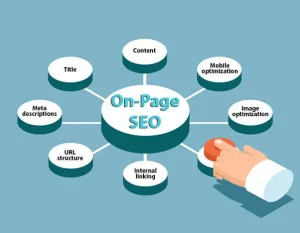
This includes elements such as:
- Page titles
- Headings
- Website content
- Keyword placement
- URLs
- Internal links
- Images and image optimization
- Meta descriptions
- Content structure
- Search intent
- User experience
The purpose is not simply to insert keywords throughout a page. Modern SEO requires much more than that. A properly optimized page should clearly address the user’s search query, provide useful information, and make it easy for both visitors and search engines to understand the subject.
Why Does On Page SEO Matter for Google Rankings?
Google’s systems need to understand the content and purpose of webpages before they can determine where those pages may be relevant in search results. Effective on page optimization helps provide clearer signals. For example, imagine a company offering ecommerce website development. A page with a vague title, poorly structured content, unclear headings, and no relevant internal links gives Google relatively little context.
Now imagine a page with a descriptive title, a clear heading structure, useful information about ecommerce development, relevant terminology, descriptive URLs, optimized images, and links to related services. The second page gives both users and search engines a much clearer understanding of what the page offers. However, optimization alone does not guarantee a particular ranking. Google considers many factors, and competition, content quality, relevance, authority, and technical performance can all influence search visibility.
1. Start With Search Intent
One of the most important parts of on page SEO is understanding why someone is searching for a particular keyword. Search intent refers to the underlying purpose behind a search.
- Someone searching for “what is SEO” is probably looking for information.
- Someone searching for “SEO services” may be evaluating service providers.
- Someone searching for “buy running shoes” has a much stronger purchasing intent.
If your content does not match the purpose behind the search, optimization becomes much less effective. Before writing or updating a page, ask: What does the person searching this keyword actually want to find? Then build the page around that expectation. This creates content that is useful rather than content that simply attempts to rank.
2. Optimize Your Page Title
The page title is one of the most important elements to consider when optimizing a webpage. It tells users and search engines what the page is about.
A strong title should be:
- Relevant to the page
- Clear and descriptive
- Naturally written
- Related to the primary keyword
- Compelling enough to encourage clicks
For example, instead of a generic title such as:
Our Services
a more descriptive title could be:
Digital Marketing Services for Growing Businesses
The second title immediately provides more context. Your target keyword should be incorporated naturally rather than forced into every title.
3. Create a Clear Heading Structure
Headings make content easier to understand.
The main page heading, usually the H1, should clearly communicate the subject of the page. Subheadings such as H2 and H3 can then organize supporting topics.
For example, an article about on page SEO could have a structure like:
H1: How On Page SEO Can Improve Your Website’s Google Rankings
H2: What Is On Page SEO?
H2: Why Does On Page SEO Matter?
H2: How to Improve On Page SEO
H3: Optimize Page Titles
H3: Improve Content Quality
H3: Strengthen Internal Linking
This structure makes long content easier for visitors to scan and helps establish relationships between different sections of the topic.
4. Create Content That Actually Answers the Query
Keywords may help search engines understand relevance, but useful content is what gives visitors a reason to stay. Instead of writing an article simply because a keyword has search volume, focus on answering the questions and concerns surrounding that keyword.
For example, a page targeting “website design” should not repeatedly mention website design in every paragraph. It should explain what effective website design involves, why it matters, what businesses should consider, and how visitors benefit from a well designed website. Natural language is important. Use related terminology where it genuinely helps explain the subject, but avoid repeating the same phrase unnecessarily.
Quality Matters More Than Keyword Repetition
Keyword stuffing can make content awkward and difficult to read. A better approach is to use the primary keyword in strategic locations while naturally discussing related concepts. For an SEO article, related terminology might include:
- Search visibility
- Search intent
- Organic traffic
- Search engines
- Content optimization
- Internal linking
- Website structure
- User experience
This creates a more comprehensive discussion without making the writing feel artificial.
5. Optimize Your URLs
A page’s URL should be simple and descriptive.
Compare:
website.com/page?id=12345
with:
website.com/on-page-seo/
The second URL gives visitors a much clearer idea of what they are about to find. A good URL structure should generally be:
- Short
- Descriptive
- Easy to understand
- Relevant to the page
- Free from unnecessary complexity
Avoid creating excessively long URLs filled with unnecessary words or parameters.
6. Strengthen Internal Linking
Internal links connect different pages within your own website. They are useful for both visitors and search engines. For visitors, internal links provide a natural way to discover related information. For search engines, they help establish relationships between pages and make it easier to discover content throughout a website. For example, an article about on page SEO could naturally link to related content about:
- Keyword research
- Technical SEO
- Website design
- Content marketing
- Local SEO
- Conversion rate optimization
The anchor text should also provide meaningful context. Instead of repeatedly using generic phrases such as “click here”, descriptive anchor text can make the relationship between pages clearer.
7. Optimize Images Properly
Images are an important part of modern websites, but they also need optimization. Large, poorly optimized images can contribute to slower page loading, particularly on mobile devices. When adding images, consider:
- File size: Compress images without unnecessarily sacrificing quality.
- File format: Use an appropriate modern format when supported.
- Dimensions: Avoid uploading an image that is significantly larger than the size at which it will actually appear.
Alt text: Use descriptive alternative text where appropriate, particularly when the image conveys meaningful information. Image optimization supports both usability and overall website performance.
8. Write Better Meta Descriptions
A meta description provides a short summary of a webpage. While it is not generally treated as a direct ranking factor, a well written description can help communicate what a page offers when it appears in search results. A useful meta description should accurately summarize the page and give the searcher a reason to consider visiting.
For example, instead of:
Learn more about SEO and our services.
a more descriptive version could explain exactly what the reader will learn from the page. Avoid writing descriptions purely for search engines. They should make sense to real people.
9. Make Your Content Easy to Read
Good on page SEO is not just about technical elements. The actual reading experience matters too. Large blocks of text can make an otherwise useful article difficult to consume. Clear paragraphs, descriptive headings, bullet points, examples, and logical transitions can make content significantly easier to navigate.
This becomes particularly important on mobile devices. A visitor should be able to quickly scan your page and understand:
What is this page about?
Does it answer my question?
Where can I find the information I need?
What should I do next?
When the answer to these questions is clear, the page becomes more useful.
How On Page SEO Works With Technical SEO
It is important not to treat on page SEO as something completely separate from technical optimization. A page can contain excellent content and still provide a poor experience if the website has serious technical problems.
For example, issues involving:
- Slow loading
- Mobile usability
- Broken links
- Poor website architecture
- Indexing problems
- Duplicate content
- Incorrect canonicalization
can interfere with how effectively search engines access and understand a website. This is why a successful SEO strategy usually combines content optimization, on page SEO, technical SEO, and off page efforts rather than relying on one area alone.
On Page SEO Is About More Than Rankings
The ultimate purpose of SEO should not be to achieve a ranking and stop there. What happens after someone clicks your result matters too. Suppose your page reaches the first page of Google but provides confusing information, loads slowly, or makes it difficult for visitors to find what they need. The ranking alone does not create business value. An effective webpage should guide visitors from search → information → trust → action.
For a business website, that action could be:
- Contacting the company
- Requesting a quotation
- Booking a consultation
- Purchasing a product
- Subscribing to a service
- Reading another useful page
This is why SEO and conversion optimization often work well together.
Common On Page SEO Mistakes to Avoid
Even businesses that actively invest in SEO can make mistakes when optimizing their pages.
Keyword Stuffing
Repeating the same keyword excessively can make content unnatural and provide a poor reading experience.
Creating Content Without Understanding Search Intent
A page may target the right keyword but still fail to satisfy what the searcher actually wants.
Ignoring Internal Links
Publishing new content without connecting it to relevant pages can make it harder for users and search engines to discover relationships between your content.
Writing for Search Engines Instead of People
SEO content should ultimately serve the reader. If a page sounds robotic or repetitive, optimization has gone too far.
Neglecting Existing Pages
SEO is not only about publishing new articles. Updating older pages with better information, clearer structure, stronger internal links, and improved relevance can also be valuable.
How DA & Co EmpowerX Can Help With On Page SEO
Effective SEO requires more than adding keywords to webpages. Being the best digital marketing agency in Dubai, we look at the broader relationship between content, website structure, search intent, user experience, and business objectives.
A strong on page SEO strategy can involve reviewing existing pages, identifying optimization opportunities, improving content structure, refining titles and headings, strengthening internal linking, optimizing images, and ensuring that each page clearly serves a particular search purpose.
The goal is to create webpages that are useful to visitors while giving search engines the context they need to understand the content. For businesses competing in increasingly crowded digital markets, this approach can provide a stronger foundation for sustainable organic growth.
Final Thoughts
On page SEO is one of the most controllable parts of a website’s search optimization strategy. By improving page titles, headings, content quality, search intent alignment, URLs, internal links, images, meta descriptions, and readability, businesses can create pages that are clearer, more useful, and easier for search engines to understand.
But SEO should never be treated as a collection of isolated tricks. The strongest results come from creating genuinely valuable content and building a website where every important page has a clear purpose. Google rankings can change over time, and no legitimate SEO strategy can guarantee a specific position. What businesses can control is the quality, relevance, structure, and usefulness of their websites.
Optimize for the searcher first, make the subject clear to search engines, and keep improving as your audience and search landscape evolve.